

By Jack Halsey
Seven months into his second presidential term, U.S. President Donald Trump, has laid claim for bringing peace to the South Caucasus.
The United States hosted an August 8, 2025, trilateral peace summit where Armenian Prime Minister Nikol Pashinyan, Azerbaijani President Ilham Aliyev, and President Trump signed a framework agreement that declares peace and prosperity in the region. During his speech, Trump recounted previous attempts from other countries and most recently the Biden Administration to broker peace between the two South Caucasus states. “Many tried to find a resolution, including the European Union. The Russians worked very hard on it. Never happened... But with this accord, we’ve finally succeeded in making peace.”
However, the previous diplomatic endeavors by Russia, the European Union, and the Biden Administration played a crucial role in setting up the Trump peace summit. By following bilateral, trilateral, and multilateral diplomatic meetings since the Second Nagorno-Karabakh war in 2020, diplomatic meetings appear to have played a key role in establishing the concrete goals and expectations for both the Armenian and Azerbaijani leaderships.
Immediately following Azerbaijan’s lightning offensive in September 2020 to take back the ethnically Armenian controlled territory of Nagorno-Karabakh, there were several attempts to broker a ceasefire. States like the U.S., France, and Russia all at one point solidified a ceasefire deal, only for it to fall apart. The conflict eventually ended on November 10, 2020, following a Russian-backed peace deal.
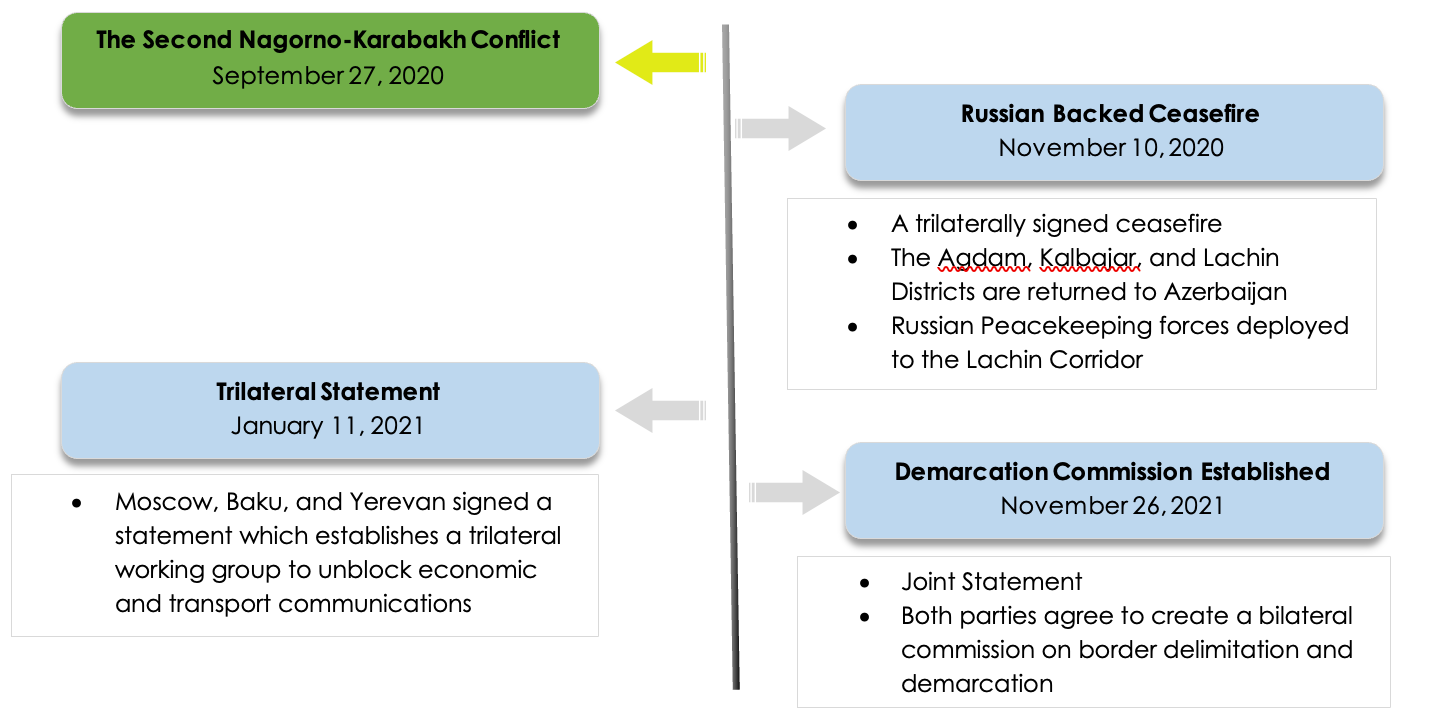
The November 10 ceasefire, signed by Pashinyan, Aliyev, and Russia’s President Putin in 2020, contained several key points. First, Azerbaijan would retain control of the Agdam District and would eventually, after a period of time, gain control of both the Kalbajar and Lachin Districts. Second, the agreement stated that Russia would deploy peacekeeping forces to the contact line in Nagorno-Karabakh and along the Lachin Corridor. Finally, Article 9 of the agreement stipulated that all economic and transport connections would be unblocked, specifically calling attention to the free movement between Azerbaijan and its exclave, the Nakhchivan Autonomous Republic.
Nearly a month later, Russia led another summit ending in another signed statement. This time, Prime Minister Pashinyan and President Aliyev agreed to establish a trilateral working group, led by the deputy prime minister of each country, to address Article 9 of the November 10 ceasefire agreement. This group was later recognized for its efforts in the following trilateral summit, but it was unclear how successful this initial group actually was.
Finally, on November 26, 2021, the trilateral summit met again in Sochi where they stated that Armenia and Azerbaijan would work towards the creation of a bilateral commission on delimitation and demarcation of the border. Russia, upon request from the parties, would play an advisory role. It was this initial step that had the largest impact on the entire diplomatic experience. Not only did it give both parties a way to meet regularly, but it also gave all mediating countries a basis from which to measure the productiveness and success of diplomacy.
For the five meetings that Russia hosted from November 2020 to November 2021, it might appear to have been a diplomatically productive year. However, three of those meetings were held within a two-month period and then an eight-month hiatus between the third and fourth meetings. The period between trilateral summits reached 10 months. Within that eight-month hiatus, there were no tangible results that seemed to bring Armenia and Azerbaijan closer to a peace agreement. What these Russian-led meetings did provide, though, was a set of agreed upon goals that a mediating group could utilize to lead the discussion. From that point on, although Armenia and Azerbaijan continued to meet with Russia, no real results came from the discussions.
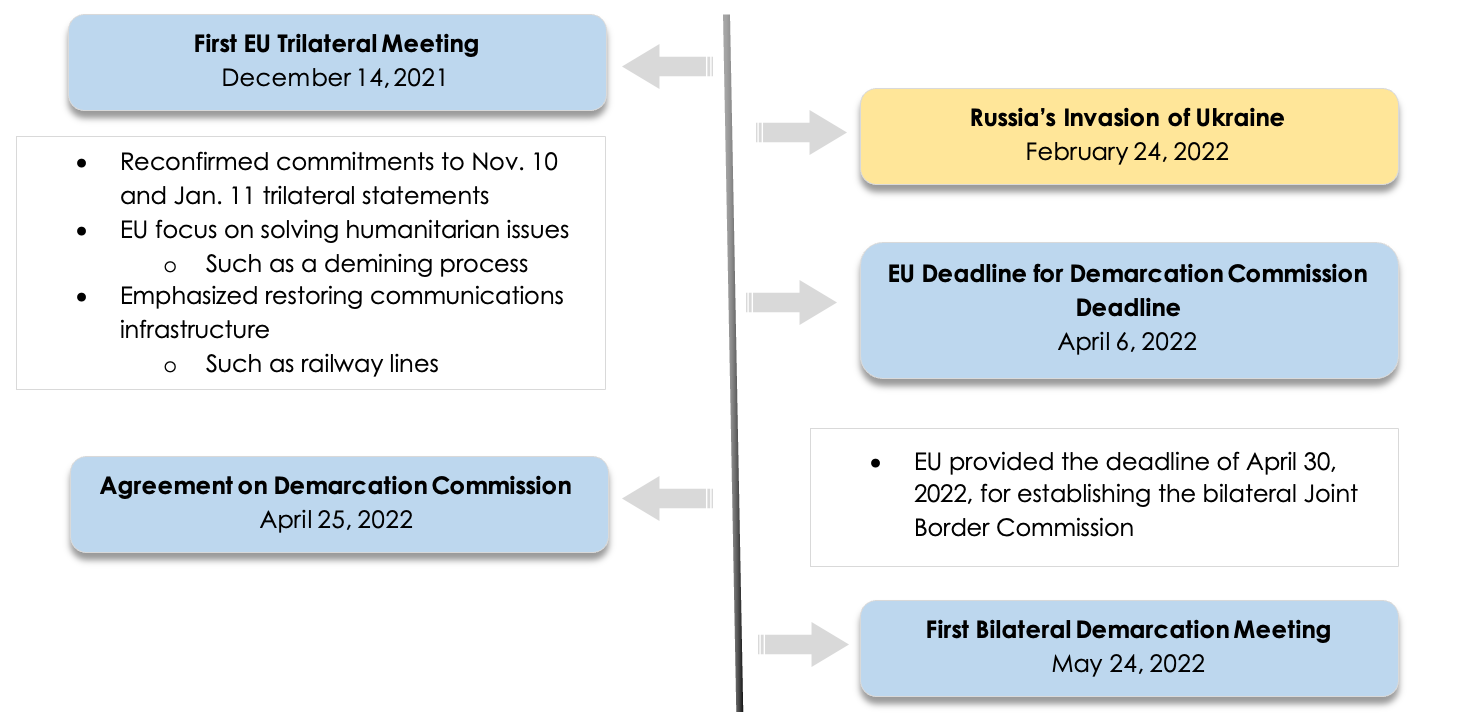
Whereas the Russian-led meetings lacked a sense of urgency and time management, the European Union meetings made sure to execute an orderly plan. From the first meeting in December 2021, the EU emphasized its priorities for Armenia and Azerbaijan as being the strengthening of communication between policymakers, as well as addressing humanitarian issues like demining. The EU’s attempt to address bilateral communication included President of the European Union Charles Michel’s facilitation to a direct communication link between each country’s minister of defense.
The EU’s ability to define goals and deadlines came to fruition in April of 2022. During the April 6 summit with President Michel, the three leaders agreed to the deadline of April 30 to establish a Joint Border Commission that would address terms laid out in the November 2020 and January 2021 trilateral statements. On April 25, a telephone call between Armenian Foreign Minister Ararat Mirzoyan and Azerbaijani Foreign Minister Jeyhun Bayramov confirmed the agreement on the structure of the demarcation commission. The first Joint Border Commission meeting, led by the deputy prime ministers, took place on May 24, 2022.
Within half the time that Russia took, the EU had set itself as the mediating power that would ensure forward momentum towards an Armenia-Azerbaijan peace agreement. This title as head mediator also came uncontested. As the EU was leading peace meetings, Russia was focused on its recent incursion into Ukraine. The next trilateral summit with Putin, the previous being November 2021, wasn’t until October 31, 2022.
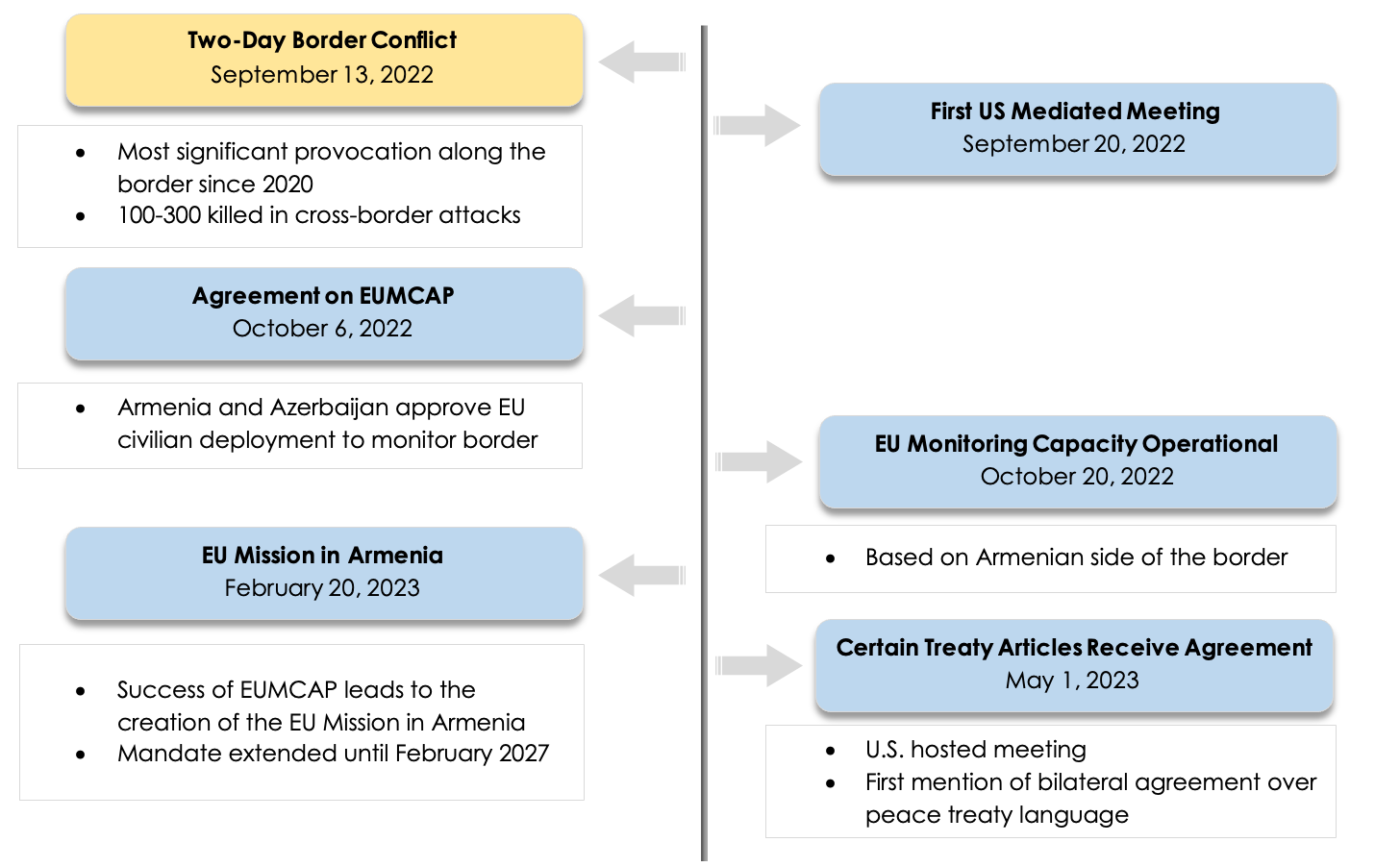
Over a two-month period, from September to October 2022, there was a spike in diplomacy with eight meetings held. Likely in response to the two-day border conflict in early September 2022, the EU, the United States, and Russia all continued to press diplomats from Armenia and Azerbaijan to keep working towards a newly demarcated border and an overall peace treaty.
It was after this border conflict that the United States hosted its first trilateral meeting between the foreign ministers and then-Secretary of State Anthony Blinken. Much like the Russian meetings, the diplomats made it clear that all parties involved were dedicated to finding a peaceful solution.
Also, following the September border dispute, Armenia and Azerbaijan both agreed to allow the EU to deploy a civilian monitoring mission for two months. With approval during the trilateral summit on October 6, 2022, the European Union Monitoring Capacity (EUMCAP) arrived on the Armenian side of the border on October 20. This monitoring mission was seen as such a success that the EU Foreign Affairs Council approved the launching of the follow-on EU Mission in Armenia (EUMA) in February 2023, with a mission mandate extended to February 2027.
The first real trace of progress on the peace treaty came in May 2023 when it was announced that language in certain articles had been bilaterally agreed upon.
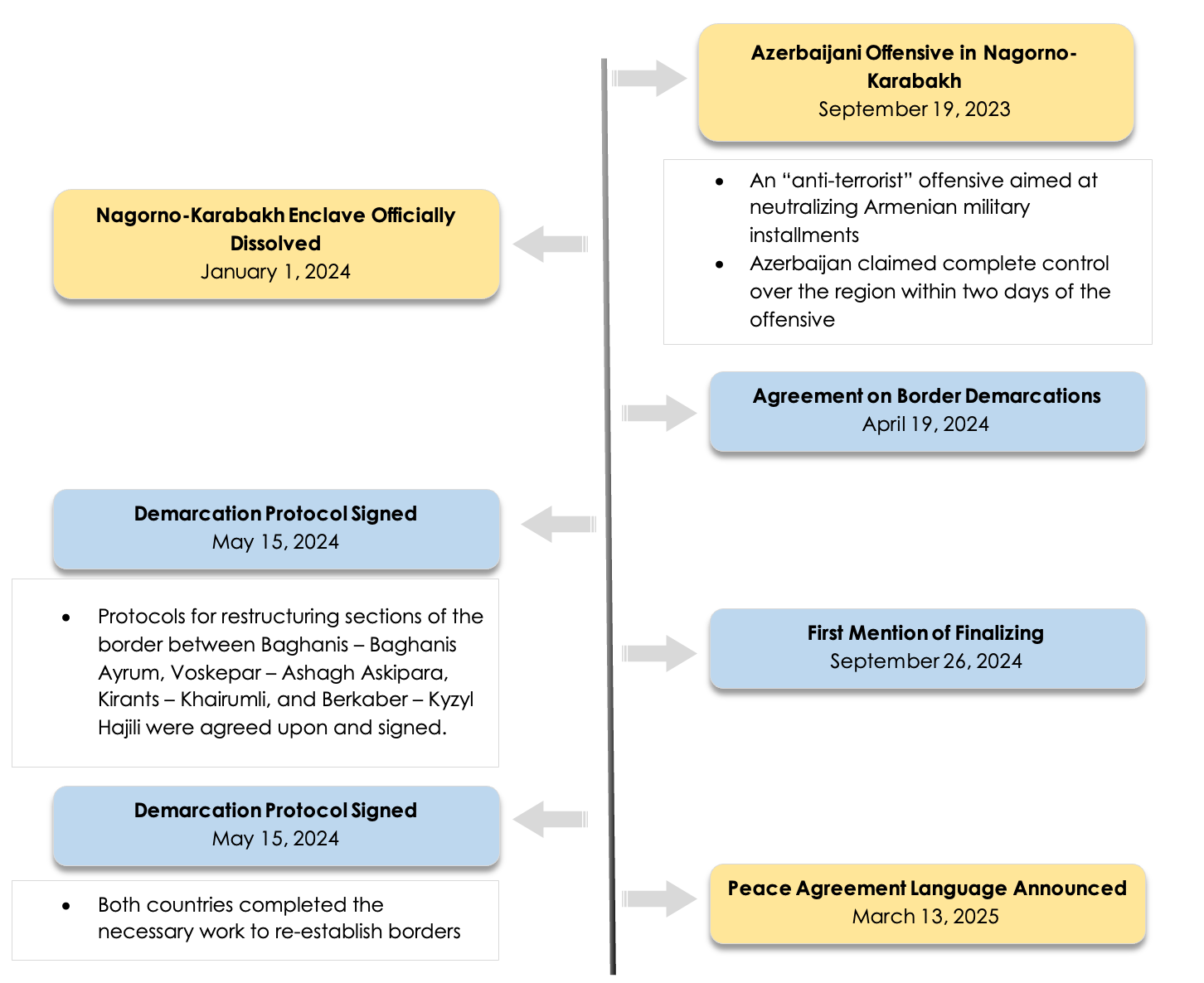
Then in Fall 2023, Azerbaijan launched what it called an “anti-terrorist” offensive, with the aim of neutralizing Armenian military installments. From this offensive, Azerbaijan was able to regain control of the entire disputed region, eventually dissolving the Armenia-occupied Nagorno-Karabakh enclave on January 1, 2024. Although Azerbaijan had made moves to control the region in its entirety, bilateral meetings went on as normal. Between September 2023 and March 2024, there were only three trilateral meetings, two with Germany and one informal meeting on the sidelines of a Commonwealth of Independent States summit.
Further strides were made during the eighth Demarcation Commission meeting, where the deputy prime ministers agreed on how sections of the border should be delimitated. Less than a month later, a protocol was signed which stated that both governments had taken steps to solidify the newly agreed border delimitations between Baghanis ((RA) – Baghanis Ayrum (AR), Voskepar (RA) – Ashagh Askipara (AR), Kirants (RA) – Khairumli (AR), and Berkaber (RA) – Kyzyl Hajili (AR).
Following the tremendous step towards peace, language in press releases began to reflect a feeling of finality, stating, “The parties agreed to make additional efforts to conclude the Agreement on Peace and the Establishment of Interstate Relations as soon as possible.” From this point in September 2024, there was only one trilateral meeting with Türkiye, while Armenia and Azerbaijan continued to meet on their own another four times before announcing on March 13, 2025, that language for the Agreement had been approved by both parties.
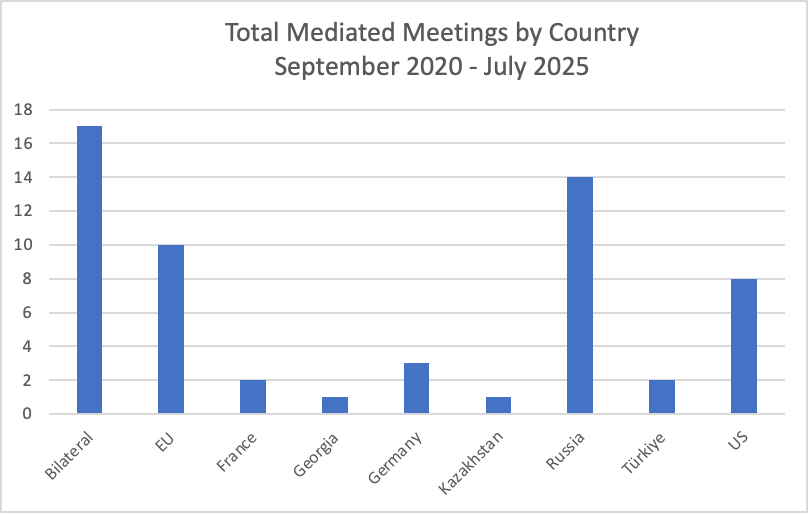
In the end, Armenia and Azerbaijan took part in 55 peace-process meetings: 17 bilateral and 38 trilateral or multilateral. Although Russian influence and diplomatic assistance began to wane in 2022, Moscow hosted a total of 14 meetings.
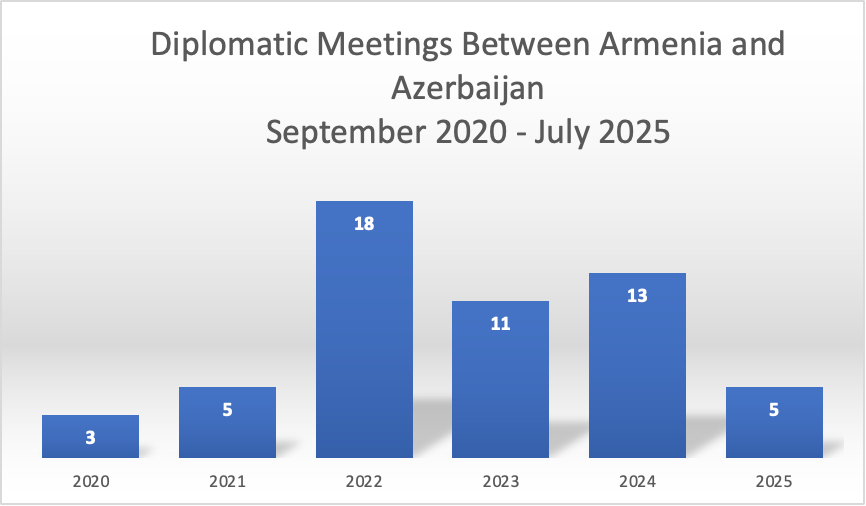
When looking at the timeline spread of meetings, 18 meetings were held during 2022, due to the rising tensions from the conflict in September 2022.
Although President Trump claims that previous attempts to broker peace between Armenia and Azerbaijan fell through, the path of diplomatic meetings spells a different story. With Russia setting the baseline on what each country required to ensure peace, other mediating countries like the EU were able to build a peace plan and push Armenia and Azerbaijan to adopt a prompt timeline to achieve the basis for peace. However, most of the credit must lie in the hands of the Armenian and Azerbaijani diplomats and leadership themselves who, through the willpower of their governments, were able to create and agree upon an acceptable agreement to ensure a continuing peace.